
Why The Last 5% of Decarbonisation Is The Hardest
Rethinking The Path To Net-Zero
Over the past decade, global momentum around decarbonization has accelerated dramatically. Governments, industries, and investors have aligned around a shared ambition: achieving net-zero emissions. And progress has been real.
Renewable energy deployment has scaled. Energy efficiency has improved. Electrification is advancing across sectors. In many regions, emissions have dropped significantly—sometimes by as much as 40–50%.
But beneath these headline achievements lies a critical reality: The final stretch of decarbonization is fundamentally different from everything that came before it.
The Cost Curve No One Talks About

Direct Air Capture is a technology designed to remove carbon dioxide directly from ambient air, rather than from industrial exhaust streams. DAC systems typically operate through three core steps:
- Air Intake: Ambient air is drawn through a capture unit.
- CO₂ Capture: A chemical sorbent selectively binds with carbon dioxide molecules.
- CO₂ Release and Storage or Use: The captured CO₂ is separated from the sorbent and can then be stored permanently or reused in industrial processes.
Unlike traditional carbon capture technologies that operate at power plants or factories, DAC removes carbon that has already accumulated in the atmosphere.
However, most existing DAC solutions rely on large centralised infrastructure, which can be costly and difficult to scale globally. This is where our approach differs.
Our Vision: Decentralised Carbon Capture

Early emissions reductions tend to be the easiest—and cheapest.
- Switching from coal to renewables
- Improving industrial efficiency
- Electrifying transport
- Optimising energy systems
These actions deliver substantial emissions cuts at relatively low cost.
However, as emissions reductions approach ~90–95%, the dynamics change dramatically. The remaining emissions are:
- Intermittent
- Distributed
- Technically complex
- Often deeply embedded in industrial processes
This is where marginal abatement costs rise sharply. In practical terms:
- Reducing the first 50% of emissions might cost tens of euros per tonne
- Reducing the next 40% may cost hundreds
- Eliminating the final 5% can exceed €1,000 per tonne
This is not a linear problem—it’s exponential.
The Stubborn Emissions Challenge

The last portion of emissions—often referred to as residual or hard-to-abate emissions—comes from sources that are inherently difficult to decarbonise:
1. Intermittent Industrial Operations
Facilities that operate only a few days per year (e.g., backup power systems) are not economically viable to fully electrify or redesign.
2. Process Emissions
Industries like cement, steel, and chemicals produce CO₂ as part of their core processes—not just from energy use.
3. Remote or Isolated Assets
Some industrial sites lack access to infrastructure for carbon transport, utilisation, or storage.
4. Legacy Systems
Existing capital-intensive infrastructure cannot always be replaced quickly or cost-effectively.
In these cases, eliminating emissions at the source becomes disproportionately expensive—and sometimes technically impractical.
A Strategic Shift: From Avoidance to Removal

At this stage, a critical insight emerges:
Beyond a certain point, removing CO₂ from the atmosphere can be more cost-effective than eliminating emissions at the source.
This is a turning point in how we think about climate solutions. Rather than viewing carbon removal as a “last resort,” it becomes a strategic complement to emissions reduction. Why is that the case…
- The cost of removal technologies is becoming increasingly competitive
- Removal can address distributed and residual emissions
- It avoids the need for costly over-engineering of marginal reductions
This is not a trade-off—it’s a system-level optimisation.
The Role of Next-Generation Carbon Capture
To address the final stages of decarbonisation effectively, we need technologies that are:
- Scalable
- Energy-efficient
- Cost-competitive
- Deployable across diverse environments
This is where next-generation carbon capture solutions play a critical role. Emerging innovations—particularly in electrochemical and modular systems—are redefining what’s possible in carbon capture and removal. These technologies aim to:
- Reduce energy intensity
- Lower operational costs
- Enable decentralised deployment
- Integrate with existing infrastructure
In doing so, they unlock new pathways to tackle emissions that were previously considered “too expensive” or “too difficult.”
Why Innovation Matters More Than Ever
The transition to net zero is no longer just about scaling existing solutions. It’s about solving the hardest problems in the most efficient way possible.
The final 5% of emissions will not be addressed through incremental improvements alone. It requires:
- Breakthrough technologies
- New economic models
- Integrated system thinking
Organizations that lead in this space will not only contribute to climate goals—they will define the future of industrial sustainability.
A More Relastic View of Net-Zero

To achieve true net zero, we must move beyond simplified narratives. Decarbonisation is not just about reducing emissions—it’s about optimising across reduction, capture, and removal.
A balanced approach recognises that:
- Not all emissions can be eliminated at the source
- The cost of reduction varies dramatically across sectors
- Carbon removal is an essential part of the solution—not an afterthought
As we enter the next phase of the energy transition, the focus must shift toward:
- Tackling hard-to-abate sectors
- Scaling advanced carbon capture technologies
- Building infrastructure for carbon management
- Driving down the cost of removal
The final stage of decarbonization is the most challenging—but also the most important. Because solving it doesn’t just get us closer to net zero. It makes net zero achievable.
A Final Thought
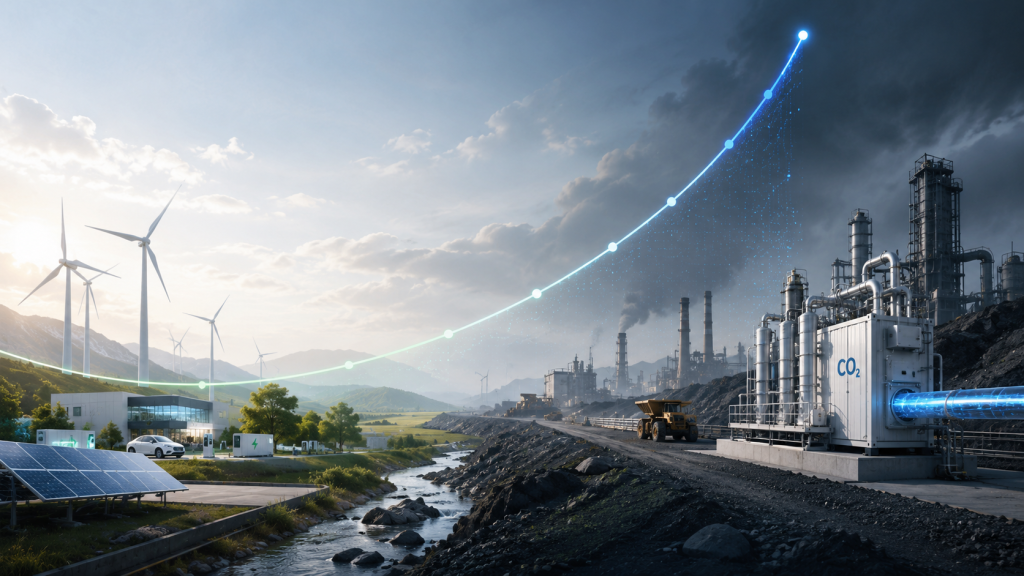
The journey to net zero is not a straight line—it’s a curve that steepens toward the end.
Understanding this curve is key to making smarter decisions, investing in the right technologies, and accelerating meaningful climate impact. The last 5% may be the hardest. But it’s also where the greatest innovation—and opportunity—lies.
CC4E is developing decentralised carbon-capture technology for the emissions conventional infrastructure struggles to reach. Explore our solution or contact our team to discuss potential applications.
